Booking app alternative for barbers: no online booking
Paying a booking platform for a chair full of regulars? An honest look for barbers at fees, trade-offs, and when the platform is still the right call.
Most booking apps for barbers are built to do two jobs at once: run your diary, and put your shop in front of strangers on a consumer app. If you need both, that can be a reasonable deal. If your week is mostly regulars who already have your number, you are paying for the second job without using it — and that is the shop this booking app alternative for barbers is written for.
This post compares the typical marketplace-style booking platform with Mobies on the things that cost money or time, and it says plainly where the platform is the better choice. If you are reading this as a customer looking for a barber, this is the wrong page — Mobies is a book for the shop owner, not an app for finding a haircut.
Who this booking app alternative is for
You are probably the right fit if most of these are true:
- Most of your bookings come from people who have been in before.
- Clients already message you on WhatsApp, or just walk in.
- You keep a tab for a few regulars and the record lives in a notebook or your head.
- You want the diary, the client notes, the tab and the day's takings in one place, on your phone, without signing up to anything.
You are probably not the right fit if you rely on new walk-in traffic from an app, or if you want clients to pick a time from a live calendar at 11pm without talking to you. Marketplace platforms do that well; Mobies does not do it at all.
A marketplace booking platform vs Mobies, side by side
Booking platforms differ, and their prices change, so the left-hand column describes how this kind of app usually works rather than any one company. Before you decide anything, open your own platform's pricing page and fill in the real figures. The Mobies column comes from the App Store listing and the app itself.
| Typical marketplace booking platform | Mobies | |
|---|---|---|
| What you pay | A monthly subscription, often per staff member, sometimes with paid add-ons | Flat monthly or yearly subscription, shown in your App Store currency |
| Fee on new clients | Some platforms take a one-time share of a new client's first visit when the marketplace sent them | None |
| Fee on returning clients | Usually none, but check — some pricing models charge per booking whoever made it | None |
| Clients book themselves from a live calendar | Yes — usually the core feature, often with a consumer app | No. Clients send a booking request by WhatsApp from your link or QR code; you add it in one tap |
| Shows your shop to new people | Yes — the marketplace listing is the point | No. There is no marketplace |
| Takes card payments | Often yes, with a processing fee per payment | No. You record whether a payment was cash, card or cheque; the money goes through your own card reader |
| Customer credit tab | Rarely part of the offer | Yes — balances per client, part payments, limits, due dates |
| Account needed | Yes — a business account, and a log-in on each device | No account, no email address |
| Works with no signal | Usually needs a connection to sync the diary | Yes — everything is stored on the phone |
| Several staff on several devices | Yes — that is what the cloud is for | No. One phone holds the book |
Three rows in that table are where Mobies loses, and they are the rows that matter most to some shops: self-service online booking, marketplace discovery and a shared diary across devices. If any of them is how you fill your chair, stay where you are.
Example: what a new-client fee does to a barber's ticket
The part of a platform's price that scales with you is any fee on new clients, so it is worth running on your own prices. The numbers below are an example calculation, not any platform's actual rate: say the fee is a one-time 25% of a new client's first visit.
On a £20 skin fade, 25% is £5. On a £15 kids' cut, it is £3.75. Ten new clients a month at £20 is £50 in fees, on top of whatever the subscription costs. Swap in your platform's real percentage and your real ticket — the shape of the sum stays the same.
That can be money well spent: a new regular who comes back every four weeks is worth far more than £5. The question is whether you need the introduction at all. If your book is already full of people you know, the more relevant number is the one in what booking platform commission really costs — the gap between a flat fee and a fee that grows as you get busier.
What running a barber shop without online booking looks like
Plenty of good shops never had online booking. The working week looks like this in Mobies:
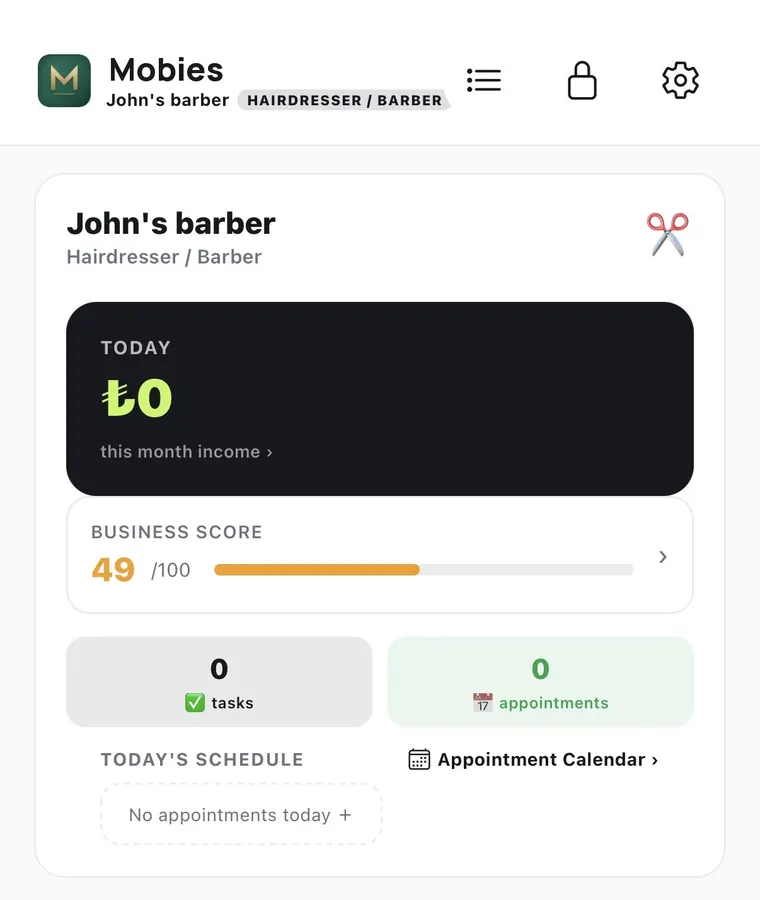
- Bookings come in by message. A client texts "Saturday 10?" — you paste it and it becomes an appointment. The booking link and the QR code on your mirror or price list open a WhatsApp chat with you, already filled in, so the request lands in the same place as everything else.
- The diary protects itself. Double-booking is blocked and the app suggests the nearest free slot.
- Reminders go out twice. A day before and a few hours before, each as a one-tap WhatsApp message. We explain why two beats one in how to cut no-shows without charging a deposit.
- No-shows are marked, not forgotten. Mark the appointment as a no-show, then add a line to the client's notes so the next booking from the same person gets a firmer confirmation.
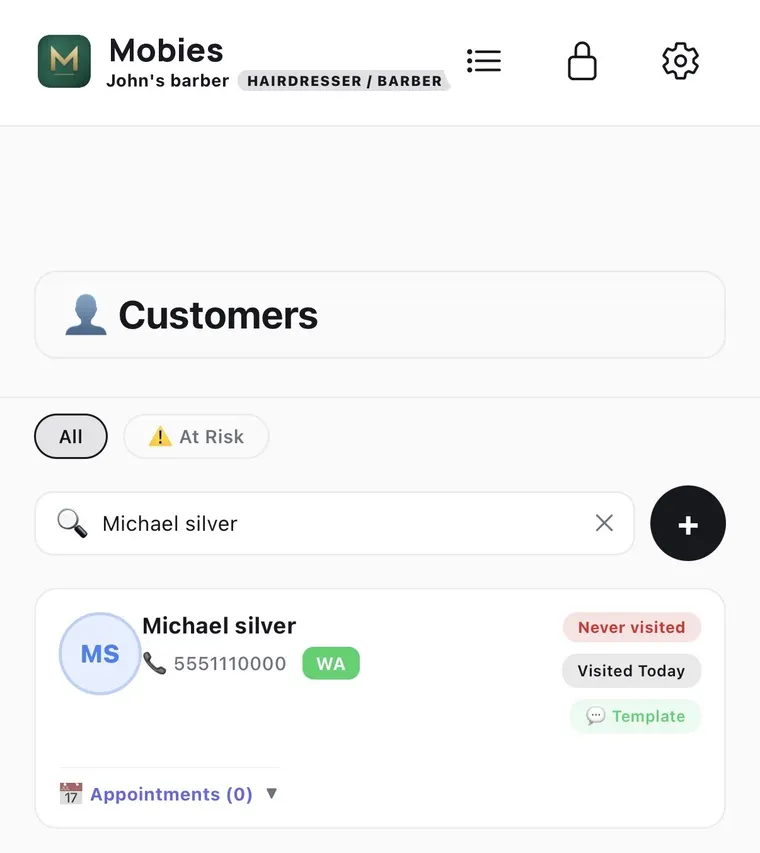
The client card holds the things a barber actually needs next time: the guard number, the parting, "hates the clippers on the neck", the birthday. The loyalty card is built in too — every Nth cut free — without a separate stamp app. If you would rather start on paper, our free hairdresser client record card has the same fields.
The part a booking app rarely covers: the tab
Most barbers run a tab for someone. A regular forgets his card, you say "get me next time", and three weeks later nobody is sure.
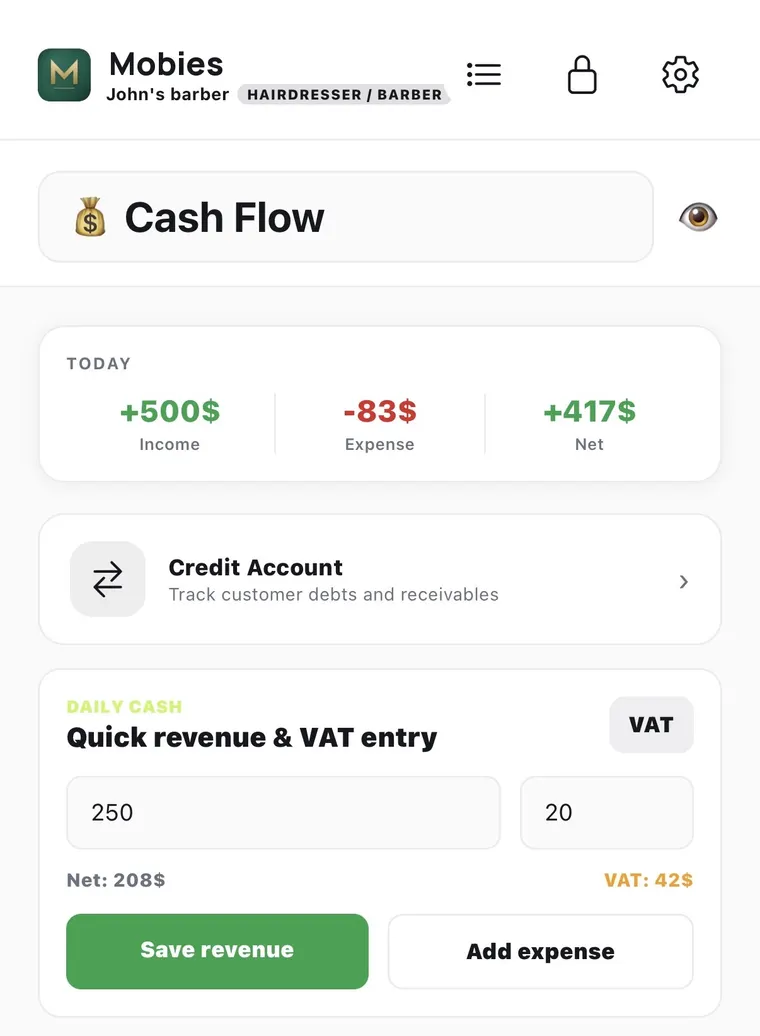
Mobies keeps that as a proper ledger: who owes what, part payments, a limit per person, a due date, and a polite WhatsApp reminder when it is time to ask. The full method is in tracking customer credit without a paper book. Whatever tool you use, the takings themselves still belong in your books — HMRC sets out what a self-employed business has to keep in its guide to business records if you're self-employed.
Honest trade-offs
Some things are worse in Mobies because of how it is built, and you should know them before you switch:
- No live online booking. Covered above. Clients message you; you confirm.
- One phone holds the book. There is no cloud account, so there is no automatic sync between two phones. You move data with an exported backup file. For a one- or two-chair shop this is usually fine; for a team that each books from their own phone, it is a real limitation.
- No card processing. Keep your own card reader.
- No Android app. Mobies is on iPhone and iPad only.
- If you stop subscribing, you can still open, search and export everything you recorded, but you cannot add new entries.
One thing does not change whichever tool you pick: client phone numbers and notes are personal data, and looking after them is your job as the shop owner. The ICO has plain-English advice for small organisations on what that means in practice.
If you run a salon or studio rather than a barber shop
The trade-offs are similar, but the fees and the client notes are different — colour formulas, patch tests, lash maps. We wrote a separate comparison: a booking platform alternative with no account and no marketplace fee.
How to try it without breaking your current setup
You do not have to leave your platform to find out. Install Mobies, look around with the sample data, then run both side by side for the 14-day trial: keep the platform for new clients, and put your regulars, their notes and any open tabs into Mobies. At the end of two weeks you will know whether the marketplace is earning its keep — and if most of your diary turns out to be people you already know, you have your answer.
The screen-by-screen tour of Mobies shows everything else in the app.
FAQ
Can my clients book online with Mobies?
Not from a live calendar. They tap your booking link or scan the QR code, a WhatsApp message to you opens already filled in, and you add the appointment in one tap.
Do I have to cancel my booking platform to try Mobies?
No. You can keep the platform for new clients during the 14-day trial, put your regulars into Mobies, and compare at the end.
Does Mobies take a commission on bookings?
No. It is a flat monthly or yearly subscription with a 14-day free trial, whoever the client is and however they booked.
Can two barbers in the same shop share one diary?
Not with automatic sync. Mobies keeps everything on one device with no server; you can move the book to another phone with an exported backup, but two phones do not stay in step on their own.
Is Mobies on Android?
No. It is available for iPhone and iPad on the App Store.
What happens to my client list if I stop paying?
Nothing is deleted or locked away. You can still open, search and export every record; only new entries need an active subscription.
Keep the whole book in one app
Bookings, client cards, credit and cash — no commission, works offline, data stays on your phone. 14 days free.
Download Mobies